Verified against primary sources
| Cost category | Estimate |
|---|---|
| 5-year depreciation | $21,192 |
| Insurance (annual) | $2,189 |
| Fuel or charging (annual) | $514 |
| Maintenance (annual) | $185 |
| Tires (annual) | $350 |
| Specification | Value |
|---|---|
| Fuel economy (MPG-equivalent combined) | 109 MPGe |
| Electric range | 236 miles |
| Horsepower | 168 hp |
| Seating capacity | 5 passengers |
| Cargo space | 27.7 cu ft |
| Pillar | Score (0–100) | Class median | Difference |
|---|---|---|---|
| Cost of ownership | 81 | 73 | +8 |
| Powertrain | 83 | 63 | +20 |
| Safety | 94 | 94 | +0 |
| Driver assistance | 49 | 43 | +6 |
| Livability | 39 | 49 | -10 |
The 2026 Toyota bZ scores 81/100 on cost of ownership — 8 points above the crossovers median. The Compact SUV class median 5-year ownership cost is $48,807 (15,000 mi/yr, national average rates). Largest annual recurring expense: insurance.
The 2026 Toyota bZ scores 49/100 on driver assistance — 6 points above the crossovers median. All scores reflect standard equipment at base MSRP; optional driver-assistance packages are not scored.
The 2026 Toyota bZ scores 83/100 on powertrain — 20 points above the crossovers median. Key figures: 109 MPG-equivalent combined, 236 miles electric range, 168 hp.
Verdict
The renamed 2026 bZ fixes the biggest complaints about Toyota's first EV: it now offers up to 314 miles of range, a standard heat pump, and — crucially — a native NACS port that opens the Tesla Supercharger network. Running costs are low, Toyota Safety Sense 3.0 is standard, and the battery carries a class-leading 10-year warranty. Trade-offs remain: DC fast charging peaks at a modest 150 kW, slower than 800-volt rivals, and like most EVs the bZ depreciates quickly. For daily commuters who charge at home and want a low-cost, well-warrantied electric SUV, the bZ finally makes sense.
Good fit for: Daily commuter
Best for
- Up to 314 miles of range with a native NACS port
- Low running costs and a 10-year battery warranty
- Toyota Safety Sense 3.0 standard
Watch out for
- 150 kW DC fast charging is slower than 800-volt rivals
- Depreciates quickly, like most EVs
2026 Toyota bZ
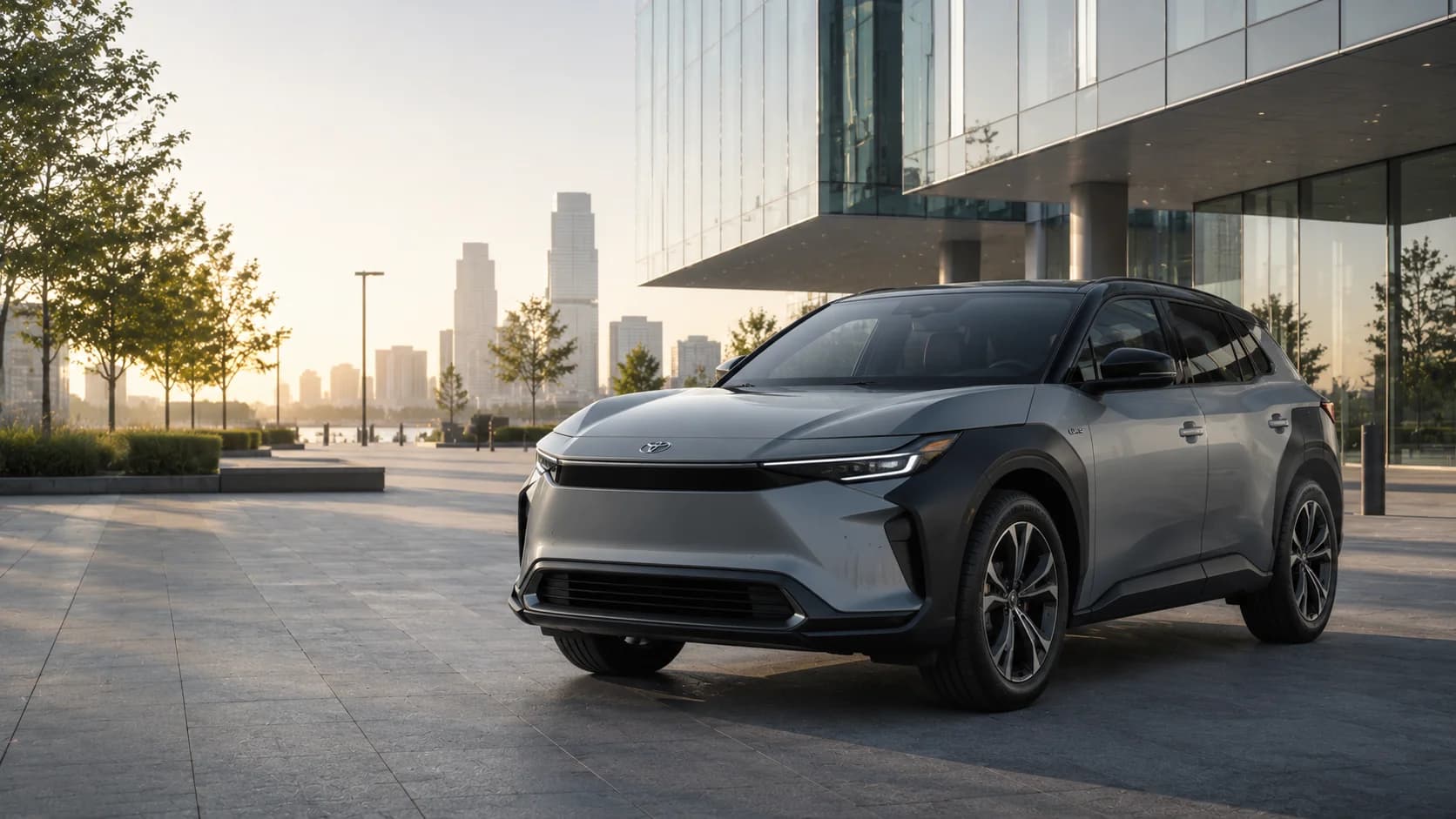
Five measured pillars, weighted into one score.
Cost, Powertrain, Driver Assistance, Livability, and Safety — each scored against its class, then combined into a single MotiveGrid Score. Built by our engineering team and benchmarked against independent sources like NHTSA, IIHS, and CarEdge. How it’s calculated →
Verdict
Based on median-price trimThe renamed 2026 bZ fixes the biggest complaints about Toyota's first EV: it now offers up to 314 miles of range, a standard heat pump, and — crucially — a native NACS port that opens the Tesla Supercharger network. Running costs are low, Toyota Safety Sense 3.0 is standard, and the battery carries a class-leading 10-year warranty. Trade-offs remain: DC fast charging peaks at a modest 150 kW, slower than 800-volt rivals, and like most EVs the bZ depreciates quickly. For daily commuters who charge at home and want a low-cost, well-warrantied electric SUV, the bZ finally makes sense.
Good fit for: Daily commuter
Daily commuters seeking low per-mile energy costs and efficient performance
Pricing & the deal
Sticker price — not a market quoteThese are the manufacturer’s sticker prices — the number you negotiate down from, not what the bZ is actually selling for near you.
Resale is rated for the model overall; the dollar loss is priced from the bZ XLE (AWD).
The bZ gives back a large share of its value in the first five years — the depreciation a lease lets someone else absorb — so it's worth pricing a lease alongside a purchase.
A consideration, not advice.
See the full 5-year cost breakdown →- NegotiableDocumentation (“doc”) fee — a dealer charge, not a government one. Often negotiable, and capped in some states.
- OptionalOptional, high-margin extras — paint or fabric protection, VIN etching, nitrogen tires, window tint, dealer “EV prep” packages, and home-charger installs. You can decline all of it, or buy it cheaper on your own later.
- FixedThe destination charge ($1,450) is set by the manufacturer and is identical at every dealer — not a negotiating lever.
Learn the terms: what to pay for a new car · MSRP vs out-the-door · which fees are negotiable · how to evaluate a lease
This is the map. Deal Check reads your quote.
Everything above is what to expect for the bZ in general. Upload a real cash, finance, or lease quote and Deal Check checks it, line by line, against this model:
- Which of these fees and add-ons are actually on your quote — and what to cut
- Whether your APR or lease money factor is marked up, with the corrected payment
- Your out-the-door (or effective lease) target for this exact trim, near you
- A word-for-word message to send the dealer
Cost of Ownership
Five-year cost is driven mostly by depreciation; maintenance is a minor share.
- Steep initial depreciation vs segment average
- Low resale demand compared to key rivals
- Insurance cost is moderate for the vehicle price
- Class ownership costs are near segment midpoint
- Low energy cost with home charging
- Minimal maintenance due to electric drivetrain
Ownership cost is competitive from low energy and maintenance, but depreciation offsets the savings.
Adjust for your situation
State
Ownership Cost
Powertrain
Electric-powertrain efficiency weighed with long-term ownership confidence.
Reliability is marked Provisional until this model has enough complaint history to rate — we don't invent a number.
Combines real-world energy efficiency (EPA-verified MPG or MPG-equivalent vs. class) with long-term ownership confidence (warranty coverage, platform maturity, and reliability data). Methodology →
Driver Assistance
Strongest in highway driving support, but parking convenience and hands-free automation are limited.
💡 Tracks where the car can drive itself (highways vs. local roads) and how much driver supervision is needed (up to fully driverless).
PoorStandard driver assist — no hands-free operation
Combines highway support, parking convenience, and hands-free automation capability into one score. Methodology →
Livability
Passenger space and everyday maneuverability, scored within its class.
Combines how comfortably this vehicle fits passengers and cargo with how easily it maneuvers in real-world conditions — normalized within its Compact SUV segment for fair comparison. Methodology →
Safety
Based on standard crash-avoidance features.
NHTSA has not assigned an overall star rating for this model year yet — its full test program (including side impact) is still in progress. The individual results shown here are final.
Combines crash-test protection — NHTSA frontal, side, and rollover ratings plus the IIHS crashworthiness sub-tests (small- and moderate-overlap front, side, headlights) — with standard crash-avoidance technology. New model years without published crash tests are scored on crash-avoidance features alone and capped until tested. Methodology →
Frequently asked questions
- What is the MotiveGrid Score for the 2026 Toyota bZ?
- The 2026 Toyota bZ earns a MotiveGrid Score of 84 out of 100. The score combines five pillars — cost of ownership, powertrain, safety, driver assistance, and livability — into one number, so you can weigh a vehicle's all-round strength at a glance.
- How is the 2026 Toyota bZ battery rated?
- MotiveGrid scores the Toyota bZ on battery longevity and charging using published capacity, thermal management, and warranty terms rather than estimates. See the battery section on this page for the full breakdown and data sources.
- What is the 2026 Toyota bZ safety score?
- The 2026 Toyota bZ earns a MotiveGrid safety score of 94/100. The score combines NHTSA and IIHS crash-test results with the standard active safety equipment included at base price.
- What driver assistance features does the 2026 Toyota bZ include?
- The 2026 Toyota bZ scores 49/100 on driver assistance. MotiveGrid evaluates only standard equipment — features included at base MSRP — across four areas: highway automation, parking support, collision avoidance, and visibility aids. Optional driver-assistance packages are not scored.
- What is the 2026 Toyota bZ fuel economy?
- The 2026 Toyota bZ is EPA-rated at 109 MPG-equivalent combined with 236 miles of electric range. MotiveGrid uses this figure as the basis for its annual fuel or charging cost estimate.
- How does the 2026 Toyota bZ rank among crossovers?
- The 2026 Toyota bZ is in the top 14% of crossovers on the MotiveGrid composite score. All vehicles in the same segment are scored on an identical five-pillar framework, making the percentile a direct comparison.
- How does the 2026 Toyota bZ compare to the Hyundai IONIQ 5?
- See the MotiveGrid side-by-side comparison page for a full breakdown across cost of ownership, safety, powertrain, driver assistance, and livability. Both vehicles are top-scored options in the crossovers segment.
- Is the 2026 Toyota bZ spacious and practical?
- The 2026 Toyota bZ scores 39/100 on livability, which covers interior passenger space, cargo capacity, and maneuverability. This score is compared directly against other crossovers in the same segment.
Analysis by the MotiveGrid Engineering Team · MotiveGrid Score last computed 2026-07-25