
Verified against primary sources
| Cost category | Estimate |
|---|---|
| 5-year depreciation | $20,180 |
| Insurance (annual) | $2,173 |
| Fuel or charging (annual) | $2,386 |
| Maintenance (annual) | $358 |
| Tires (annual) | $430 |
| Specification | Value |
|---|---|
| Fuel economy (combined) | 22 MPG |
| Fuel economy (city / highway) | 19 / 27 MPG |
| Engine | 3.5L V-6 SOHC i-VTEC |
| Horsepower | 285 hp |
| Torque | 262 lb-ft |
| Seating capacity | 8 passengers |
| Cargo space | 18.6 cu ft |
| Pillar | Score (0–100) | Class median | Difference |
|---|---|---|---|
| Cost of ownership | 71 | 62 | +9 |
| Powertrain | 60 | 60 | +0 |
| Safety | 75 | 95 | -20 |
| Driver assistance | 43 | 49 | -6 |
| Livability | 53 | 53 | +0 |
The 2026 Honda Pilot scores 71/100 on cost of ownership — 9 points above the 3-row suvs median. The 3-Row SUV class median 5-year ownership cost is $65,569 (15,000 mi/yr, national average rates). Largest annual recurring expense: fuel or charging.
The 2026 Honda Pilot scores 43/100 on driver assistance — 6 points below the 3-row suvs median. All scores reflect standard equipment at base MSRP; optional driver-assistance packages are not scored.
The 2026 Honda Pilot scores 60/100 on powertrain. Key figures: 22 MPG combined, 285 hp.
Verdict
The 2026 Pilot delivers eight-passenger seating with a five-star NHTSA safety rating and Honda's standard driver-assistance suite. Ownership costs are reasonable for a three-row SUV, and reliability is solid. Fuel economy and cargo space are mid-pack — the Pilot prioritizes passenger comfort over maximum cargo volume. For families who need three rows and want Honda's reputation for safety and durability, the Pilot is a capable and trustworthy choice.
Good fit for: Family hauler
Best for
- Five-star NHTSA overall safety rating
- Eight-passenger seating with Honda reliability
- Driver-assistance standard across all trims
Watch out for
- Fuel economy is mid-pack for the three-row segment
- Cargo space prioritizes passenger comfort over volume
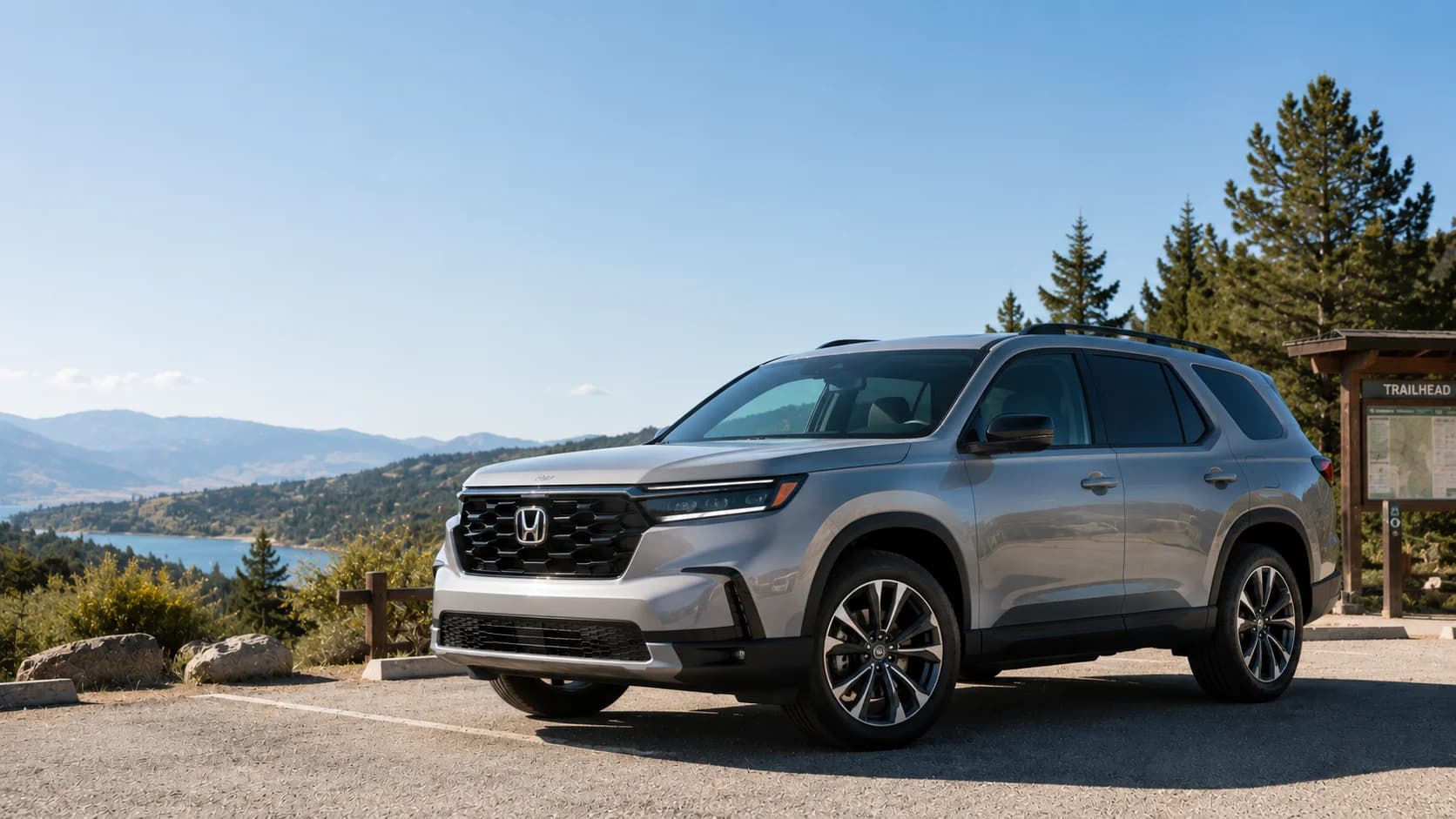
2026 Honda Pilot
Five measured pillars, weighted into one score.
Cost, Powertrain, Driver Assistance, Livability, and Safety — each scored against its class, then combined into a single MotiveGrid Score. Built by our engineering team and benchmarked against independent sources like NHTSA, IIHS, and CarEdge. How it’s calculated →
Verdict
Based on median-price trimThe 2026 Pilot delivers eight-passenger seating with a five-star NHTSA safety rating and Honda's standard driver-assistance suite. Ownership costs are reasonable for a three-row SUV, and reliability is solid. Fuel economy and cargo space are mid-pack — the Pilot prioritizes passenger comfort over maximum cargo volume. For families who need three rows and want Honda's reputation for safety and durability, the Pilot is a capable and trustworthy choice.
Good fit for: Family hauler
Families who prioritize passenger space, cargo room, and safety ratings
Cost of Ownership
Five-year cost is driven mostly by depreciation; maintenance is a minor share.
Adjust for your situation
State
Ownership Cost
Powertrain
Fuel efficiency weighed with long-term ownership confidence.
Reliability from NHTSA complaint records, adjusted for how many were sold. How we measure it
Combines real-world energy efficiency (EPA-verified MPG or MPG-equivalent vs. class) with long-term ownership confidence (warranty coverage, platform maturity, and reliability data). Methodology →
Driver Assistance
Strongest in highway driving support, but parking convenience and hands-free automation are limited.
💡 Tracks where the car can drive itself (highways vs. local roads) and how much driver supervision is needed (up to fully driverless).
PoorStandard driver assist — no hands-free operation
Combines highway support, parking convenience, and hands-free automation capability into one score. Methodology →
Livability
Passenger space and everyday maneuverability, scored within its class.
Combines how comfortably this vehicle fits passengers and cargo with how easily it maneuvers in real-world conditions — normalized within its 3-Row SUV segment for fair comparison. Methodology →
Safety
Crash-test protection combined with standard crash-avoidance features.
Combines crash-test protection — NHTSA frontal, side, and rollover ratings plus the IIHS crashworthiness sub-tests (small- and moderate-overlap front, side, headlights) — with standard crash-avoidance technology. New model years without published crash tests are scored on crash-avoidance features alone and capped until tested. Methodology →
Frequently asked questions
- What is the MotiveGrid Score for the 2026 Honda Pilot?
- The 2026 Honda Pilot earns a MotiveGrid Score of 70 out of 100. The score combines five pillars — cost of ownership, powertrain, safety, driver assistance, and livability — into one number, so you can weigh a vehicle's all-round strength at a glance.
- Is the 2026 Honda Pilot safe?
- The Honda Pilot carries an NHTSA overall safety rating of 5 out of 5 stars. MotiveGrid's safety pillar pairs federal crash-test results with the standard active-safety equipment fitted at base price.
- What is the 2026 Honda Pilot safety score?
- The 2026 Honda Pilot earns a MotiveGrid safety score of 75/100. The score combines NHTSA and IIHS crash-test results with the standard active safety equipment included at base price.
- What driver assistance features does the 2026 Honda Pilot include?
- The 2026 Honda Pilot scores 43/100 on driver assistance. MotiveGrid evaluates only standard equipment — features included at base MSRP — across four areas: highway automation, parking support, collision avoidance, and visibility aids. Optional driver-assistance packages are not scored.
- Is the 2026 Honda Pilot reliable?
- The 2026 Honda Pilot has an average reliability profile for its class, based on NHTSA complaint data. MotiveGrid calculates a reliability proxy score of 57/100 from complaint rates per 1,000 vehicles sold over a trailing multi-year window.
- What is the 2026 Honda Pilot fuel economy?
- The 2026 Honda Pilot is EPA-rated at 22 MPG combined. MotiveGrid uses this figure as the basis for its annual fuel or charging cost estimate.
- How does the 2026 Honda Pilot rank among 3-row suvs?
- The 2026 Honda Pilot is in the top 71% of 3-row suvs on the MotiveGrid composite score. All vehicles in the same segment are scored on an identical five-pillar framework, making the percentile a direct comparison.
- How does the 2026 Honda Pilot compare to the Chevrolet Traverse?
- See the MotiveGrid side-by-side comparison page for a full breakdown across cost of ownership, safety, powertrain, driver assistance, and livability. Both vehicles are top-scored options in the 3-row suvs segment.
- Is the 2026 Honda Pilot spacious and practical?
- The 2026 Honda Pilot scores 53/100 on livability, which covers interior passenger space, cargo capacity, and maneuverability. This score is compared directly against other 3-row suvs in the same segment.
Analysis by the MotiveGrid Engineering Team · MotiveGrid Score last computed 2026-07-03